

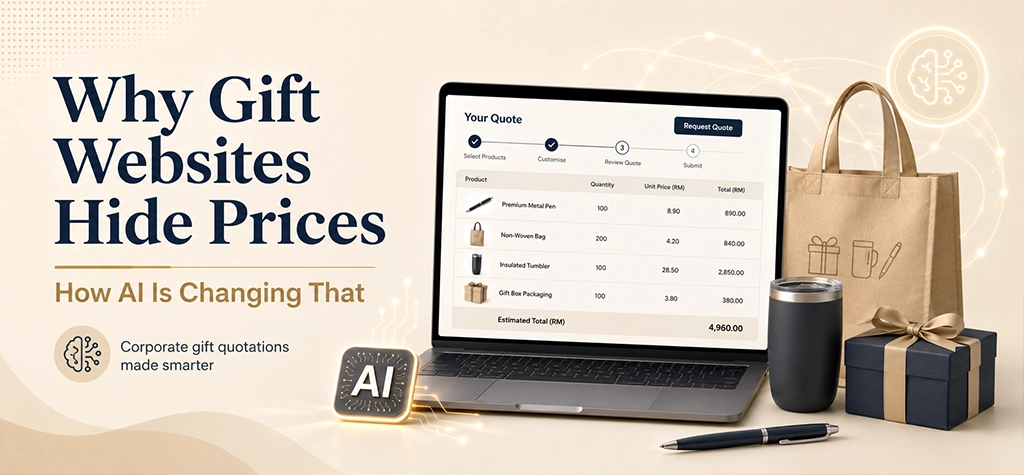
Why Many Corporate Gift Websites Still Hide Prices — And How AI Is Changing That

Many buyers have probably noticed the same thing when visiting a corporate gift website: hundreds of products may be displayed, but the final prices are often missing.
Instead, customers are asked to WhatsApp the supplier, send an email, or submit an enquiry before receiving a quotation. From the outside, this may look outdated or unnecessarily complicated.
However, the real reason is usually not that suppliers are trying to hide their prices. Pricing in the corporate gift industry is simply much more complicated than pricing an ordinary retail product.
For businesses sourcing corporate gifts in Malaysia, understanding this difference helps explain why instant online pricing has taken so long to become common — and why AI-assisted development may now begin to change that.
🧾 Why Corporate Gift Prices Are Often Hidden
A normal retail product usually has one selling price. A corporate gift may have several possible prices depending on how the customer configures the order.
The final amount may depend on:
- order quantity
- product colour
- logo printing method
- number of printing positions
- setup charges
- mixed-colour requirements
- packaging and other custom requests
Even the same pen may have a different unit price at 100, 500, or 1,000 pieces. Silkscreen printing, UV printing, and laser engraving may also involve different setup charges and production rules.
This is why many corporate gift suppliers still rely on sales staff to calculate every quotation manually. A standard online shopping cart cannot easily understand all these combinations without substantial customisation. Customers who want to understand the available branding options can also review the different printing methods for corporate gifts.
💻 Why Custom Quotation Systems Used to Be Expensive
Building a real quotation system involves much more than designing a form and placing a “Get Quote” button on a website.
Behind the screen, the system may need to manage:
- product pricing databases
- quantity discount tiers
- printing charges and setup costs
- product and printing compatibility
- colour and SKU information
- quotation PDF generation
- customer selections and admin controls
- testing, security, and future maintenance
Traditionally, a business would need to hire programmers, explain every industry rule, review multiple prototypes, and pay for repeated revisions. Depending on the complexity, custom development could easily cost tens of thousands of ringgit, with larger systems requiring substantially more.
For many traditional SMEs, the investment and technical uncertainty made the project difficult to justify — even when the existing manual quotation process was taking up a great deal of staff time.
🤖 How AI Is Changing the Development Process
AI-assisted development does not make custom software free, but it can significantly reduce the repetitive work involved in building and improving it.
AI can help developers and business owners:
- organise business requirements
- plan pricing logic
- create early prototypes
- write repetitive sections of code
- identify bugs and inconsistencies
- prepare testing scenarios
- improve staff-facing interfaces
- document how the system works
Tasks that once required many rounds of manual coding can now be developed, reviewed, and adjusted more efficiently. This lowers the barrier for SMEs that need software built around their actual workflow instead of forcing their business to fit a generic system.
More importantly, customisation becomes more practical. A company can refine the system step by step as its needs become clearer, rather than trying to pay for every possible feature from the beginning.
🧠 AI Still Needs Real Industry Knowledge
AI may help write code, but it does not automatically understand how the corporate gift industry operates.
It does not know which quantity tier should apply, whether a printing setup is included, how mixed colours should be handled, or which branding methods are suitable for a particular material unless these rules are clearly defined.
A system can look polished and operate smoothly while still producing the wrong quotation if its business logic is incorrect.
That is why successful AI-assisted development still requires three important elements: real industry experience, careful human review, and proper testing. AI helps turn business knowledge into software, but the knowledge must still come from people who understand the work.
⚡ What Online Quotations Mean for Corporate Gift Buyers
Customers are not especially interested in how the system was coded. What matters to them is whether the buying process becomes faster and easier.
With a properly built online quotation workflow, buyers can:
- browse available products
- select a preferred colour
- choose logo printing
- enter the required quantity
- view the calculated price
- compare several products
- generate a formal quotation online
They no longer need to send separate messages asking how much 500 pieces will cost, what happens when logo printing is added, or whether another printing method will change the price.
The result is clearer budget planning, fewer back-and-forth messages, and access to quotation information even outside normal office hours.
🏭 What This Means for Traditional SMEs
Corporate gifting is only one example. Many traditional businesses still rely on knowledge that exists mainly in the minds of owners and experienced staff.
AI-assisted development gives SMEs a more practical way to convert some of that knowledge into useful digital tools. These may include quotation systems, stock management, supplier mapping, artwork preparation, order processing, or internal staff workflows.
The goal should not be to add AI everywhere simply because it is available.
A better starting point is to identify the repeated manual process that wastes the most time, creates the most mistakes, or causes the most frustration for customers — and then decide whether technology can improve it.
🚀 Our Takeaway
At GiftsDepot.my, our online quotation feature was developed to make corporate gift pricing easier for buyers to understand.
Customers can browse products, select the relevant options, enter their quantity, and prepare a quotation without waiting for every basic calculation to be completed manually.
This does not remove the need for an experienced sales team. Complex gift sets, unusual printing requests, customised packaging, and special campaigns may still require personal assistance.
AI is not replacing industry knowledge. It is helping traditional businesses turn that knowledge into more practical digital tools.