

Is Silkscreen Printing Becoming a Sunset Industry in Corporate Gifts?

For many years, silkscreen printing was one of the most common methods used in corporate gifts printing. It was practical, affordable, and especially suitable for one-color logo printing on large quantity orders. For simple artwork, it used to be one of the most cost-effective logo printing methods in the market.
Today, however, the market is changing. More customers want faster turnaround, more color flexibility, and more consistent results. As newer methods such as UV DTF transfer, UV DTF sticker, UV printing, and heat transfer become more widely used, traditional silkscreen printing is no longer the automatic first choice it once was.
This does not mean silkscreen is completely dead. In fact, for certain one-color and budget-sensitive jobs, it is still one of the most economical options for custom corporate gifts. But there is no denying that silkscreen printing is slowly losing ground in a market that now values speed, flexibility, and lower production risk.
Today, however, the market is changing. More customers want faster turnaround, more color flexibility, and more consistent results. As newer methods such as UV DTF transfer, UV DTF sticker, UV printing, and heat transfer become more widely used, traditional silkscreen printing is no longer the automatic first choice it once was.
This does not mean silkscreen is completely dead. In fact, for certain one-color and budget-sensitive jobs, it is still one of the most economical options for custom corporate gifts. But there is no denying that silkscreen printing is slowly losing ground in a market that now values speed, flexibility, and lower production risk.
🖨️ Why Silkscreen Printing Was Once So Popular?
There was a reason why silkscreen printing remained strong for so many years.
It is simple, practical, and cost-effective for one-color logo printing, especially when the quantity is high. For companies that only need a straightforward logo on bags, bottles, pouches, folders, or other promotional items, silkscreen has traditionally been one of the cheapest and most widely used printing methods for corporate gifts.
For simple branding work, it still has value today.
It is simple, practical, and cost-effective for one-color logo printing, especially when the quantity is high. For companies that only need a straightforward logo on bags, bottles, pouches, folders, or other promotional items, silkscreen has traditionally been one of the cheapest and most widely used printing methods for corporate gifts.
For simple branding work, it still has value today.
⚠️ Silkscreen Printing Depends Heavily on Skilled Workers
One of the biggest weaknesses of silkscreen printing is that it depends heavily on the experience of skilled workers.
This is not a method where everything can be solved by just pressing a machine button. A good silkscreen result often depends on the printer’s hand feel, pressure control, ink consistency, alignment, positioning, and years of real production experience. In other words, silkscreen printing is still a skill-based craft.
If the job is handled by an experienced master, the print can look clean, sharp, and properly positioned.
But if the operator lacks experience, mistakes can happen very easily.
This is not a method where everything can be solved by just pressing a machine button. A good silkscreen result often depends on the printer’s hand feel, pressure control, ink consistency, alignment, positioning, and years of real production experience. In other words, silkscreen printing is still a skill-based craft.
If the job is handled by an experienced master, the print can look clean, sharp, and properly positioned.
But if the operator lacks experience, mistakes can happen very easily.
👜 One Wrong Print Can Waste the Entire Product
Take a premium bag as an example.
If a silkscreen logo is printed wrongly — whether it is misaligned, smudged, too heavy, too light, or leaves unwanted marks on the product surface — the mistake usually cannot be corrected. Unlike some other methods, silkscreen printing on finished products cannot simply be wiped off and redone.
Once the print goes wrong, the whole bag may have to be thrown away.
That is already painful for low-cost products. But if the item is a premium bag worth hundreds of ringgit each, the loss becomes much more serious. One printing mistake caused by insufficient experience can easily turn into a costly waste.
This is one of the harsh realities of traditional silkscreen printing that many people outside the industry do not see. The method may look simple, but in actual production, it carries real risk.
If a silkscreen logo is printed wrongly — whether it is misaligned, smudged, too heavy, too light, or leaves unwanted marks on the product surface — the mistake usually cannot be corrected. Unlike some other methods, silkscreen printing on finished products cannot simply be wiped off and redone.
Once the print goes wrong, the whole bag may have to be thrown away.
That is already painful for low-cost products. But if the item is a premium bag worth hundreds of ringgit each, the loss becomes much more serious. One printing mistake caused by insufficient experience can easily turn into a costly waste.
This is one of the harsh realities of traditional silkscreen printing that many people outside the industry do not see. The method may look simple, but in actual production, it carries real risk.
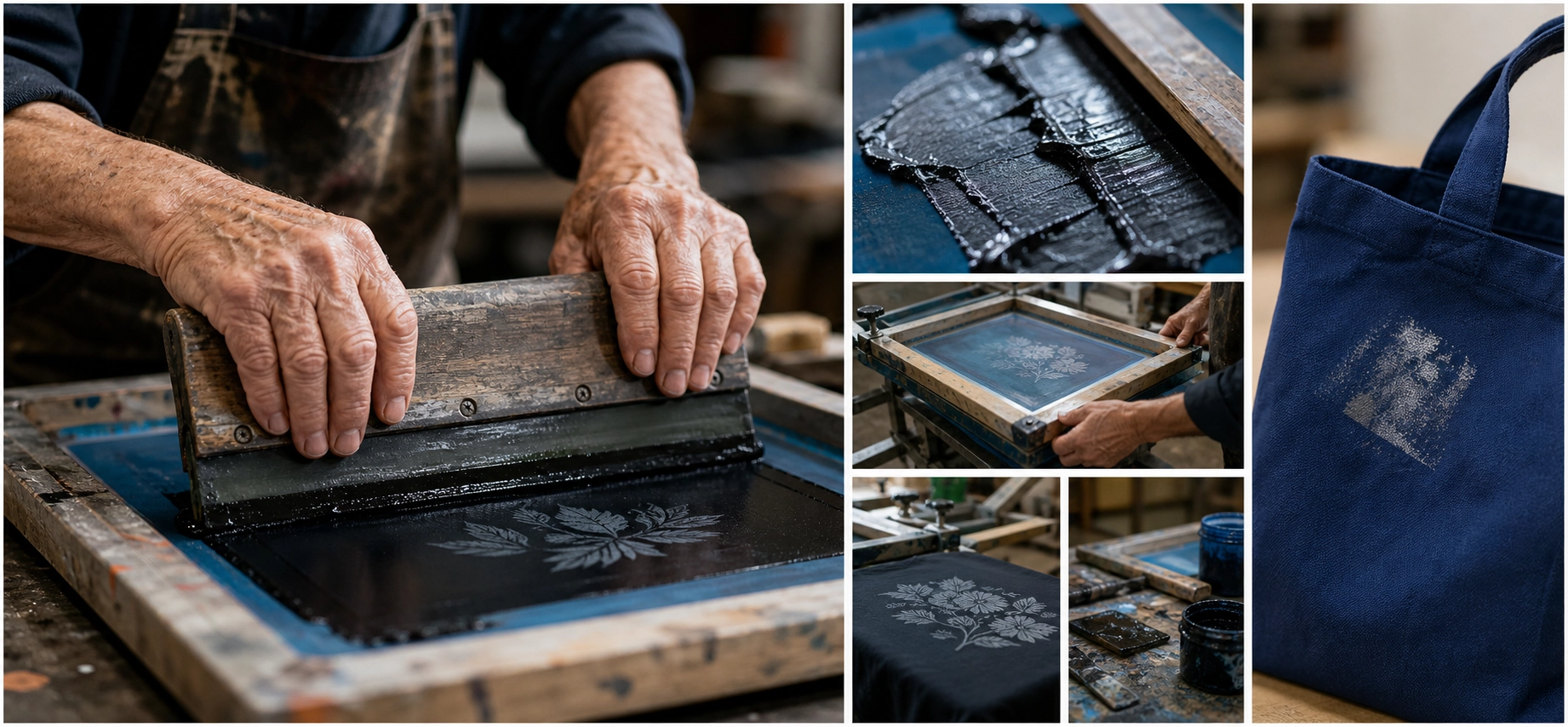
Here is a quick visual example of how logo application and surface finishing matter in real production work:
🔄 Why More Businesses Are Moving to Other Printing Methods
As customer expectations continue to change, more businesses are moving towards methods such as UV DTF transfer, UV DTF sticker, UV printing, and heat transfer.
The reason is quite clear.
These newer methods are often more suitable for:
The reason is quite clear.
These newer methods are often more suitable for:
- multi-color logos
- finer artwork details
- smaller quantity runs
- faster turnaround
- more consistent finishing
When a logo contains multiple colors or more complex artwork, silkscreen printing often becomes less practical. Each extra color may require additional setup, additional alignment, and additional risk. Compared with newer methods, silkscreen is less flexible when customers want colorful logos, detailed graphics, or lower production risk.
This is why, in many situations, traditional silkscreen is gradually being replaced.
This is why, in many situations, traditional silkscreen is gradually being replaced.
👨🏭 Why Fewer People Want to Continue This Trade?
Another major issue is manpower.
Silkscreen printing is not an easy trade to learn. It is technical, tiring, messy, and highly dependent on practical skill. It takes time to master, and the cost of mistakes can be high. Because of this, fewer young people are willing to enter and continue this type of work.
As older and more experienced printers retire, the industry may struggle to find enough skilled hands to carry this traditional craft forward.
That is why some people now see silkscreen printing as a slowly shrinking trade in certain parts of the corporate gifts printing industry.
Silkscreen printing is not an easy trade to learn. It is technical, tiring, messy, and highly dependent on practical skill. It takes time to master, and the cost of mistakes can be high. Because of this, fewer young people are willing to enter and continue this type of work.
As older and more experienced printers retire, the industry may struggle to find enough skilled hands to carry this traditional craft forward.
That is why some people now see silkscreen printing as a slowly shrinking trade in certain parts of the corporate gifts printing industry.
📉 Is Silkscreen Printing Still Relevant Today?
The honest answer is yes — but only in the right situation.
For one-color logo printing, simple artwork, and larger quantity orders, silkscreen printing can still be one of the most affordable and practical options available. It has not completely disappeared, and it still has a place in the right application.
But it is no longer the safest or most flexible choice for every project.
In today’s market, where customers often want more colors, faster lead times, lower risk, and more stable output, methods like UV DTF transfer, UV DTF sticker, UV printing, and heat transfer are becoming more attractive alternatives.
For one-color logo printing, simple artwork, and larger quantity orders, silkscreen printing can still be one of the most affordable and practical options available. It has not completely disappeared, and it still has a place in the right application.
But it is no longer the safest or most flexible choice for every project.
In today’s market, where customers often want more colors, faster lead times, lower risk, and more stable output, methods like UV DTF transfer, UV DTF sticker, UV printing, and heat transfer are becoming more attractive alternatives.
💡 Our Honest View
In our view, silkscreen printing is not disappearing overnight.
However, it is slowly shifting from being a mainstream default printing method to becoming a more traditional technique that only suits selected jobs. It still works, and it can still be cost-effective, but it now depends more and more on experienced printers who truly understand the craft.
That is why the real question today is no longer whether silkscreen can still print well.
It definitely can.
The real question is whether the industry still has enough skilled masters willing to continue this traditional printing method in the years ahead.
At the same time, businesses looking for printing methods for corporate gifts should understand that every method has its own strengths. The best choice depends on the artwork, the material, the quantity, the budget, and the level of risk involved.
For simple one-color jobs, silkscreen may still be the right answer.
But for many modern branding needs, the market is clearly moving towards more flexible alternatives.
However, it is slowly shifting from being a mainstream default printing method to becoming a more traditional technique that only suits selected jobs. It still works, and it can still be cost-effective, but it now depends more and more on experienced printers who truly understand the craft.
That is why the real question today is no longer whether silkscreen can still print well.
It definitely can.
The real question is whether the industry still has enough skilled masters willing to continue this traditional printing method in the years ahead.
At the same time, businesses looking for printing methods for corporate gifts should understand that every method has its own strengths. The best choice depends on the artwork, the material, the quantity, the budget, and the level of risk involved.
For simple one-color jobs, silkscreen may still be the right answer.
But for many modern branding needs, the market is clearly moving towards more flexible alternatives.