

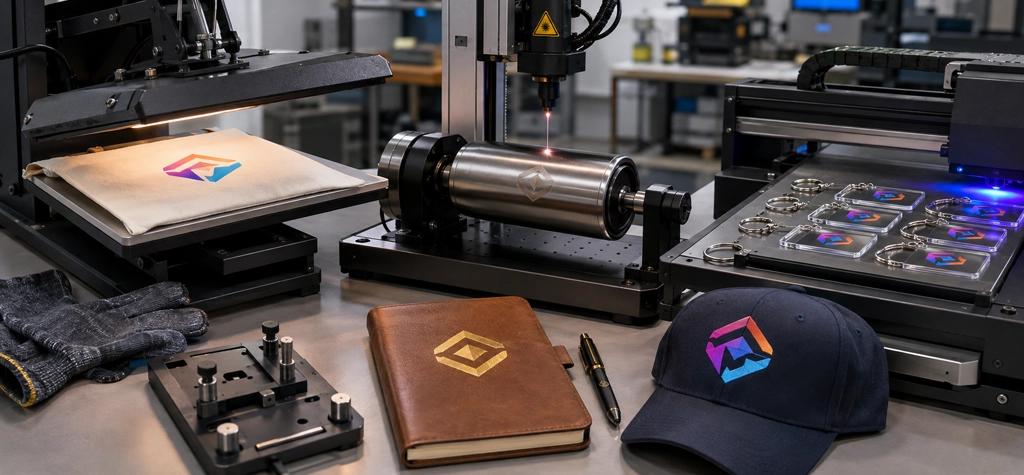
DTF, UV, Silkscreen or Laser? A Gift Printer’s Honest Guide to Logo Printing

Here’s a conversation that happens in our factory at least once a week. A customer sends a beautiful logo — nice gradient, fades from blue into purple — and asks for it on 500 tumblers. We quote, they approve, and then comes the question we’ve learned to answer before it’s asked: “Will it look exactly like this?”
Honest answer: not exactly. And the reason why — plus what we do about it — tells you almost everything you need to know about choosing a printing method. So here’s the plain-English version of what each method actually does, written by people who run the machines, not by a catalogue.
The 10-Second Chooser 🧭
| Method | Best on | Colours | The honest catch |
|---|---|---|---|
| Silkscreen | Non-woven bags, plastic pens, flat surfaces | Solid colours, 1–2 | No gradients, ever |
| DTF / heat transfer | Fabric — totes, apparel, pouches | Full colour | Screen colour ≠ printed colour |
| UV printing | Hard surfaces — acrylic, metal, wood | Full colour | Curved surfaces need testing |
| Laser engraving | Metal pens, tumblers, wood | No colour — engraved | One mistake = product scrapped |
| Hot stamping | PU leather — diaries, cardholders | Gold / silver foil | Clean shapes only |
| Debossing | PU leather, kraft paper | No colour — pressed | Subtle by design |
| Embroidery | Caps, thick fabric, backpacks | Thread colours | Fine text turns to mush |
This table is the shortcut, not the gospel — every product page lists its own supported printing options, and that listing wins.
The Gradient Problem (Read This Before Anything Else) 🎨
The single hardest thing to print on a corporate gift is a gradient logo. Not because machines can’t print gradients — DTF and UV do it all day — but because the colour you see on your screen is not the colour that comes out of the machine. Your screen glows; ink doesn’t. Every screen shows colour differently, and then the material itself shifts the colour again — press the same transfer onto two different fabrics and you’ll get two slightly different logos.
Customers find this hard to believe until they see it. We find it hard to explain until they see it. So here’s what we actually do about it:
We print a white underbase behind your artwork, tucked in about 0.1mm smaller than the design. The white layer stops the material’s colour from bleeding through and shifting your logo’s tone, and the 0.1mm inset means the white never peeks out around the edges. That one production habit kills roughly 90% of the logo problems we used to see. It’s not glamorous. It works.
💡 One honest expectation-setter: the digital mock-up we send you confirms the artwork, size and position — it is not a physical colour proof. Screens cannot show you how foil, thread or ink-on-fabric will actually look. When colour is mission-critical (rebrand launches, strict brand guidelines), ask us about a printed sample or test press before the full run — sometimes it costs a little time, and sometimes it saves the whole order.
If your logo is a flat, solid colour — congratulations, you’ve just made every printer in Malaysia happy, and almost every method on this page will serve you well.
DTF Printing — the New Favourite 🖨️
DTF (direct-to-film) is the method everyone’s been asking about lately, and for fabric it has mostly earned the hype: full-colour, fine detail, and it holds onto fabric better than old-school vinyl transfers. We run DTF in-house, which is exactly why the gradient warning above exists — we see the screen-versus-print gap every single day, and the white underbase is how we close it.
Where we use it: non-woven bags when the artwork is too colourful for silkscreen, canvas totes with photo-style prints, and drawstring pouches.
Heat Transfer — DTF’s Older Cousin ♨️
Heat transfer covers a family of press-it-on methods, DTF included. The classic version is great for multi-colour artwork on bags and apparel, with one extra thing to watch: the material underneath changes the result. The same transfer can look slightly different on cotton versus polyester versus non-woven — another colour shift on top of the screen-versus-ink one. It’s manageable (underbase again, plus a test press), but it’s why we ask what the artwork is going on before we promise anything.
UV Printing — Full Colour on Hard Things 💎
UV printing cures ink with ultraviolet light directly onto hard surfaces — acrylic, metal, wood, plastic. It’s how an acrylic keychain gets a full-colour logo and how a mascot ends up looking sharp on a power bank. We run UV in-house too. Flat surfaces are its happy place; tight curves need a test run first, which is one more reason every order gets an artwork preview before production.
One cousin worth knowing: UV DTF — the artwork is UV-printed onto a transfer film first, then applied to the product. We use it for hard surfaces that a printer can’t reach directly (odd shapes, recessed panels). Same full-colour capability, slightly different feel — it sits on the surface as a transfer rather than ink printed straight on. Which one your product needs is part of the artwork check.
Silkscreen — the Old Workhorse 🎯
One colour, pressed through a mesh screen, one layer at a time. Still the most cost-effective way to put a solid-colour logo on non-woven bags and plastic pens at volume — which is why it refuses to die. Just don’t bring it a gradient; silkscreen doesn’t do “fade”, it does “solid”.
We’ve actually written a whole separate piece asking whether silkscreen is becoming a sunset industry — short version: not yet, and the reasons are interesting.
Laser Engraving — Premium, Permanent, Unforgiving ⚡
Laser engraving burns your logo into metal, wood or stainless steel. It never rubs off, never fades, and on a metal pen or stainless tumbler it simply looks expensive.
Now the part suppliers don’t usually say out loud: laser has no undo button. If an engraving goes wrong on a premium product, that product is scrap — there’s no wiping it off and going again. On expensive items the wastage risk is real money, which is why we jig-test and sample before committing a full premium run, and why engraving jobs on high-value products deserve a little more lead time than “can do by Friday?”. We run laser in-house, so this caution comes from our own scrap bin, not a textbook. 🗑️
Hot Stamping & Debossing — the PU Leather Duo 👑
These two are the best-behaved methods in the building. Debossing presses your logo into PU leather or kraft paper — no ink, no foil, just a clean indent that reads as quietly premium. Hot stamping is the same press with gold or silver foil, and it’s what most clients pick for year-end diaries and cardholders because it photographs beautifully.
Both want clean, bold logo shapes. Hairline fonts and tiny details don’t press well — if your logo has them, we’ll flag it at the artwork check and suggest a simplified version.
Embroidery, Pad & the Rest 🧵
Embroidery stitches your logo in thread — the premium look for caps, thick totes and backpacks, with real texture you can feel. Keep text above roughly 5mm tall or letters turn into thread-mush. Pad printing handles small or curved spots that other methods can’t reach (think pen clips), and roller printing suits round barrels — both are workhorse methods we reach for when the product shape demands it. And epoxy doming — a full-colour print sealed under a clear raised resin dome — gives selected keychains and badges that glossy, dimensional finish you have definitely seen on car badges.
So Which One Do You Actually Need? 🤝
Shortcut version, based on what’s leaving our factory:
- Non-woven or canvas bag, solid logo → silkscreen. Colourful logo → DTF.
- Metal pen or stainless tumbler → laser engraving, no contest.
- Acrylic keychain, power bank, hard plastic → UV (or full-colour paper insert on selected keychains).
- PU diary or cardholder → hot stamping for shine, debossing for subtle.
- Cap or backpack → embroidery.
- Gradient logo on anything → talk to us first. White underbase, managed expectations, no surprises. 😄
Every product page on our site lists its available printing options with live pricing — pick quantity plus printing and the per-piece cost shows instantly. For the full service rundown, see our corporate gift printing services page.
Quick Answers❓
Why does my printed logo look different from my screen?
Because screens emit light and ink reflects it — no printed colour can match a glowing screen exactly, and the material underneath shifts the tone further. We close most of the gap with colour-managed artwork and a white underbase layer printed 0.1mm inside your design, then send you a preview before production so there are no surprises.
Is DTF printing better than heat transfer?
For most fabric corporate gifts, DTF gives finer detail and better wash durability than classic vinyl-style transfers, at full colour. Classic heat transfer still earns its keep on certain materials and large simple prints. In practice we choose based on your artwork and the exact fabric — that’s part of the artwork check, not an extra service.
Which printing method lasts the longest?
Laser engraving — it’s burned into the material, so it cannot rub off, fade or peel. Debossing is similarly permanent since it reshapes the surface itself. Printed methods (silkscreen, UV, DTF) are durable with normal use but live on the surface.
Do you check artwork before printing?
Yes, every order. Our team checks your file, flags anything that won’t reproduce cleanly — gradients on silkscreen, hairline fonts on hot stamping, fine detail at small sizes — and sends a preview for approval before production starts. Send AI, EPS or editable PDF for the smoothest ride.